Federation
This section explains how to use the federation setup. For a component to support federation, it must implement the following methods:
def to_binary(self) -> bytes | None:
    """(Federation only) Serialize to bytes for federation operations."""

def load_binary(self, binary: bytes) -> None:
    """(Federation only) Deserialize from bytes and update instance for federation operations."""

def aggregate_strategy(self, components: set["FedOperations"]) -> None:
    """(Federation only) Define how to aggregate a set of federated components."""

def finalize_federation(self) -> None:
    """(Federation only) Liberate memory from federation"""
The tracker detectors (subclasses of base_detectors.TrackerDetector: New Event, New Value, New Value Combo, Value Range, Charset, Event Sequence, SCVS and ECVC) implement all four in TrackerDetector, which is the reference implementation. Set allow_fed: true in their params to enable it.
The Bigram Frequency detector is also a tracker detector, but it disables the binary transfer: its to_binary() returns empty bytes. It therefore supports Combine first only, not Stack later.
from_binary rebuilds the detector as type(self)(name=..., config=...), so a TrackerDetector subclass must be constructible from its name and config alone; give any other constructor argument a default.
There are two main ways to use federation:
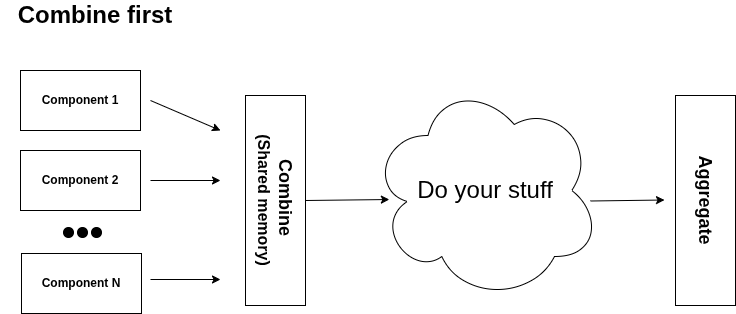
- Combine first: This can only be used when all components run locally. The main idea is to simplify the process by allowing components to share memory.
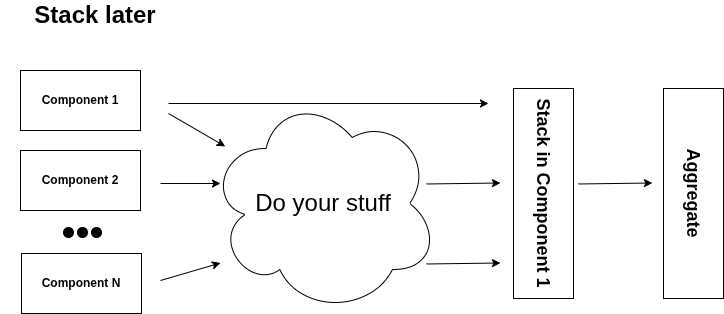
- Stack later: A more standard federated approach where the "weights" or state of each component are combined at the end.
Example class
For all the examples below, we will use this code:
from detectmatelibrary.common.core import CoreComponent
import struct


class NewComponent(CoreComponent):  # Inherit from CoreComponent
    def __init__(self, elems):
        self.elems = elems
        super().__init__(name="FedExample")

    def aggregate_strategy(self, components):
        final_list = []
        for component in components:
            final_list.extend(component.elems)

        final_list = list(set(final_list))
        for component in components:
            component.elems = final_list

    def to_binary(self):
        return struct.pack(f">{len(self.elems)}h", *self.elems)

    def from_binary(self, binary):
        num_ints = len(binary) // 2
        elems = list(struct.unpack(f">{num_ints}h", binary))
        return NewComponent(elems=elems)
Combine first
The diagram below shows the workflow:
Example 1:
detector1 = NewComponent([1, 2, 3])
detector2 = NewComponent([4, 5])
detector3 = NewComponent([6])

detector1 + detector2 + detector3

detector2.aggregate()  # Detector 2 is used as central node

print("Detector 3", detector3.elems)  # All detectors have been updated
Example 2:
detector1 = NewComponent([1, 2, 3])
detector2 = NewComponent([4, 5])
detector3 = NewComponent([6])

detector1 + detector2 + detector3

detector2.aggregate()  # Detector 2 is used as central node

print("Detector 3", detector3.elems)  # All detectors have been updated
Stack later
The diagram below shows the workflow:
Example 1:
detector1 = NewComponent([1, 2, 3])
detector2 = NewComponent([4, 5])
detector3 = NewComponent([6])

detector1.stack([detector2, detector3])

detector2.aggregate()
print("Detector 3", detector3.elems)  # It is no longer combined but stacked, so it will not work

detector1.aggregate()
print("Detector 3", detector3.elems)  # Now it will work
Example 2:
detector1 = NewComponent([1, 2, 3])

binary2 = NewComponent([4, 5]).to_binary()
binary3 = (detector3 := NewComponent([6])).to_binary()
print("Binary of Detector 3", binary3)

detector1.stack([binary2, binary3])
output = detector1.aggregate(unstack=True)  # unstack = True will free memory

print("Detector 1", detector1.elems)  # Detector 1 has been updated
print("Output binary", output)  # Output that we send to other components

# We update detector 3 now
print("Detector 3", detector3.elems)  # Now detector 3 is not in the shared memory, so it will not work
detector3 = detector3.from_binary(output)
print("Detector 3", detector3.elems)  # Now it will work